

I have looked up to 6sense for years.
They proved something that changed how big companies sell. Most of your buyers make up their minds long before they ever raise a hand. They read, they compare, they ask people they trust, and by the time a form gets filled out, the shortlist already exists. 6sense gave that invisible part of the process a name and then built a real business on reading it. That is a genuine contribution to the craft. I still read everything they publish.
So this is not a takedown. It is closer to the opposite. I want to explain why an idea I admire cannot reach the companies I work with, and why the reason has very little to do with the price tag.
The job everyone is actually buying
Take away the category names and the job is simple. See the signal early enough to be in the conversation before the shortlist gets written.
That job is worth a lot to a company with a thousand employees, and they pay accordingly. Real 2026 quotes for 6sense sit somewhere between $40,000 and $200,000 a year depending on seats, data volume and modules, and you can find current pricing breakdowns with the numbers laid out. Nobody at that size is confused about why they are signing. They have hundreds of sellers and tens of thousands of accounts, and even a small lift in timing pays for the contract several times over.
The 30-person company down the road needs the same job done. Same buyers, same invisible process, same disadvantage from walking in late. What they cannot do is buy the thing that does it.
The first barrier everyone sees
Price, obviously. A $60,000 platform is a non-starter when your whole sales budget is $200,000 including salaries.
I want to move past this quickly, because price is the barrier that gets all the attention and explains the least. If money were the only problem, a cheaper 6sense would solve it. People have tried. The market is full of intent tools at a tenth of the cost, and a graveyard of small companies who bought one, used it for a quarter, and quietly stopped logging in.
Cheaper did not fix it. So price is a symptom. There are two barriers underneath it, and both are structural.
Barrier two: the radar arrives, the crew never does

Every enterprise intent platform is sold as a radar, and it works like one. But a radar is only half of a system. The other half is the crew that watches it and decides what to do.
At a 900-person company that crew already exists and nobody thinks of it as part of the purchase. There is a RevOps person who owns the scoring model. There is a CRM the team mostly trusts, with real owners and current stages. There is a demand gen team turning segments into campaigns every week, and there is somebody whose actual job is reading the dashboard and writing the plays that come out of it.
At a 30-person company that crew is a founder, two sellers, and a busy week. Nobody owns the scoring model because nobody has time to own anything that does not close this month. The HubSpot has three versions of the same company in it. The dashboard gets opened with real enthusiasm the week it goes live, again a week later, and then never again.
This is also why the cheap tools failed. They sold the same radar for less money to the same missing crew. The enemy was never the price. The enemy is a seller walking into a conversation blind while a tool nobody operates makes noise in the background.
Barrier three: the part nobody talks about
Here is the one I find genuinely interesting, and the reason I stopped believing a smaller 6sense was the answer.
Statistical intent needs volume. That is not a criticism, it is just how the method works. You watch content consumption across a very large publisher network, you compare an account's behaviour this week to its own baseline and to everyone else's, and you surface the ones that spiked. To do that you need enough traffic per account to tell a spike from a normal Tuesday. The math is built on crowds.
A big enterprise is watching 10,000 or 50,000 accounts. Plenty of crowd. The scores mean something.
A small sales team's entire world is 100 to 500 named accounts. Regional. Specific. The manufacturers within a day's drive, the general contractors who bid the kind of work you support, the forty firms in your niche. At that size the per-account data is too thin to read. Three people from one company looked at two articles. Is that a buying committee or one curious estimator? Statistically you cannot tell, and a score that cannot tell you is worse than no score, because it still asks for your attention.
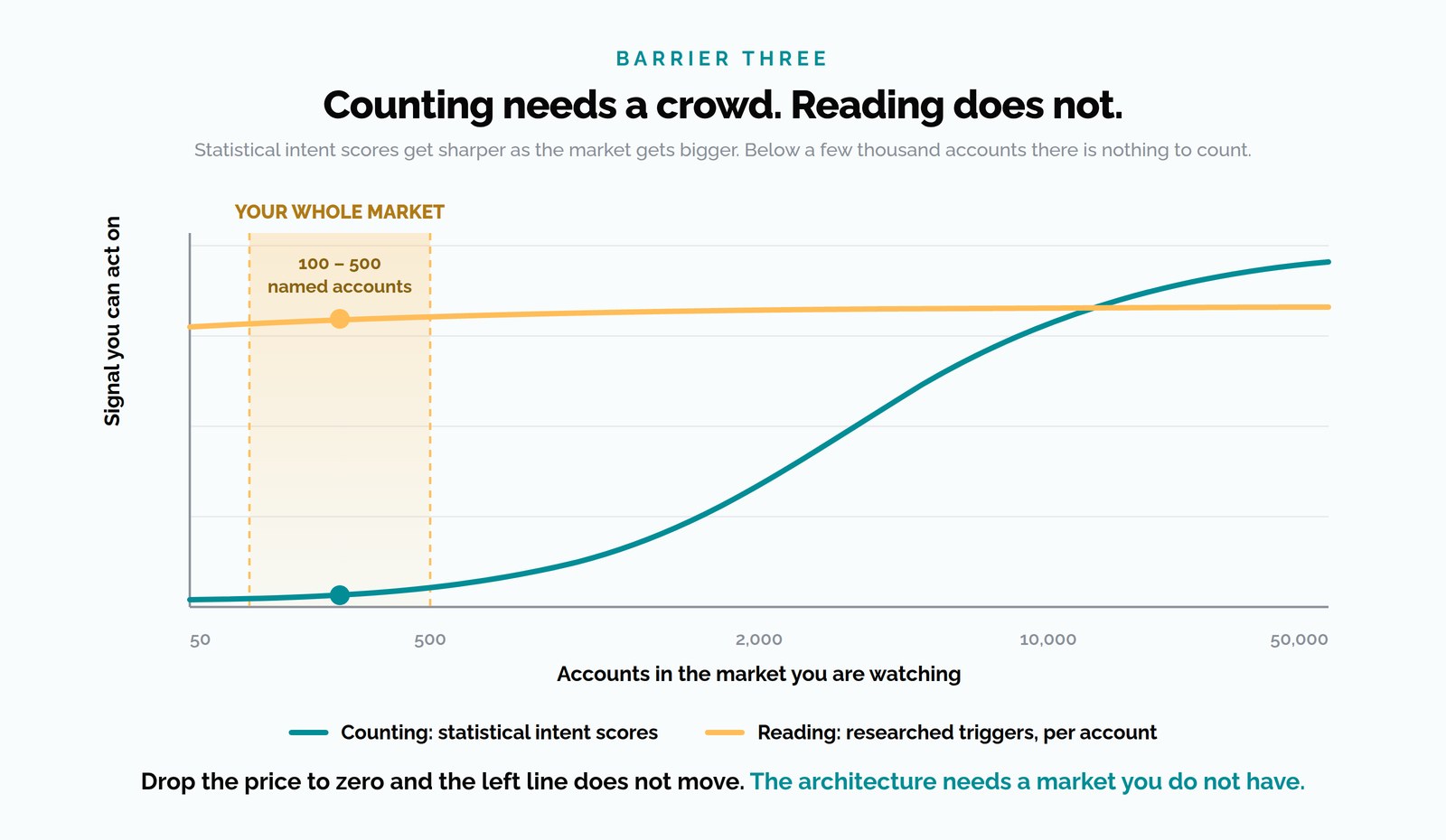
This is the part that took me a while to accept. 6sense could drop its price to zero tomorrow and it still would not work for a 30-person company. The architecture requires a market bigger than the customer has. You cannot discount your way out of physics.
What works at 200 accounts
Where counting starves, reading feeds.
Two hundred accounts is a terrible number for statistics and a wonderful number for research. It is small enough that something can genuinely read all of them, week after week, and large enough that a human never could.
And when you read instead of count, the signal changes shape. You stop looking for a score between 1 and 100 and start looking for facts with names and dates on them. A new VP of Sales who started in March and is now rebuilding the process. A funding round sized exactly wrong for the enterprise tools they will get pitched. A plant opening. A city contract award posted in council minutes. A careers page that just added three roles in the one function that always breaks first when a company grows.
None of that is intent data. It is better. It is a reason, and a reason survives contact with a real conversation in a way a score never does. A seller cannot open with "our platform says you are at 87." A seller can absolutely open with "saw the rec centre award, congratulations, usually intake is what breaks first when a job that size lands."
Machines do the heavy lifting. Humans do the last mile. That split is the whole design.
The delivery model is the product
Here is the part I got wrong for a while. I thought the answer was to build a smaller, cheaper radar and sell it. It is not, because the missing crew is still missing. If I hand a founder a better dashboard, I have handed them a better thing to not open.
So we run it. The radar and the crew arrive together, as a service, and what the client's team receives is not software. It is a card.

Monday morning, a short list of accounts that moved. For each one: what happened, where we saw it, why it matters this week, who to call, and a first line their seller can use without rewriting it. That is it. No login required, no model to tune, no scores to interpret. A seller reads it in four minutes and makes a call they would not otherwise have made.
The results have been better than I expected, and more consistent than anything we did before. Forty-two qualified conversations in ninety days for one client. A $5 million opportunity that started from a single signal nobody on the team had seen. A K-12 account that came from a board agenda item published three weeks before the RFP existed.
None of that came from a smarter score. It came from reading carefully and handing a person one specific thing to do about it.
What I actually believe
6sense built the right idea for the market they built it for. I hope they keep going, because the category exists partly because they made the case for it.
But below 150 employees the same idea needs a different shape. Not a cheaper radar. A radar with a crew attached, aimed at a market small enough to read, delivering reasons instead of scores. That is the company I am building, and the physics above is why.
Try it on an account that matters to you
If you have one account you want to win, name it. The engine will send you its live Intel Card within 48 hours. No call required, nothing to install, no pitch attached.
If the card is good, you will know exactly what we do. If it is not, you have lost two days and gained a free piece of research on an account you care about.